Buyer Guides
Footwear Packaging and Carton Planning for Wholesale Orders
A practical guide to product protection, shoe-box sizing, master-carton configuration, labels, dimensional weight, packaging trials, and shipment inspection.
LEFUSHOES · 2026-11-10
Contents
Footwear packaging for wholesale orders should protect the product, identify it accurately, support warehouse handling, and use shipping space responsibly. A reliable packaging plan begins with the finished, packed shoe—not with a generic shoe-box dimension—and then carries approved information through the retail box, inner packing, master carton, labels, packing list, and shipment inspection.
Packaging is often finalized later than the product, but it affects cost, damage risk, customer experience, carton quantity, freight calculations, and distribution-center acceptance. Buyers can avoid many late-stage problems by treating packaging as a controlled product specification from the beginning.
What Is Included in a Footwear Packaging System?
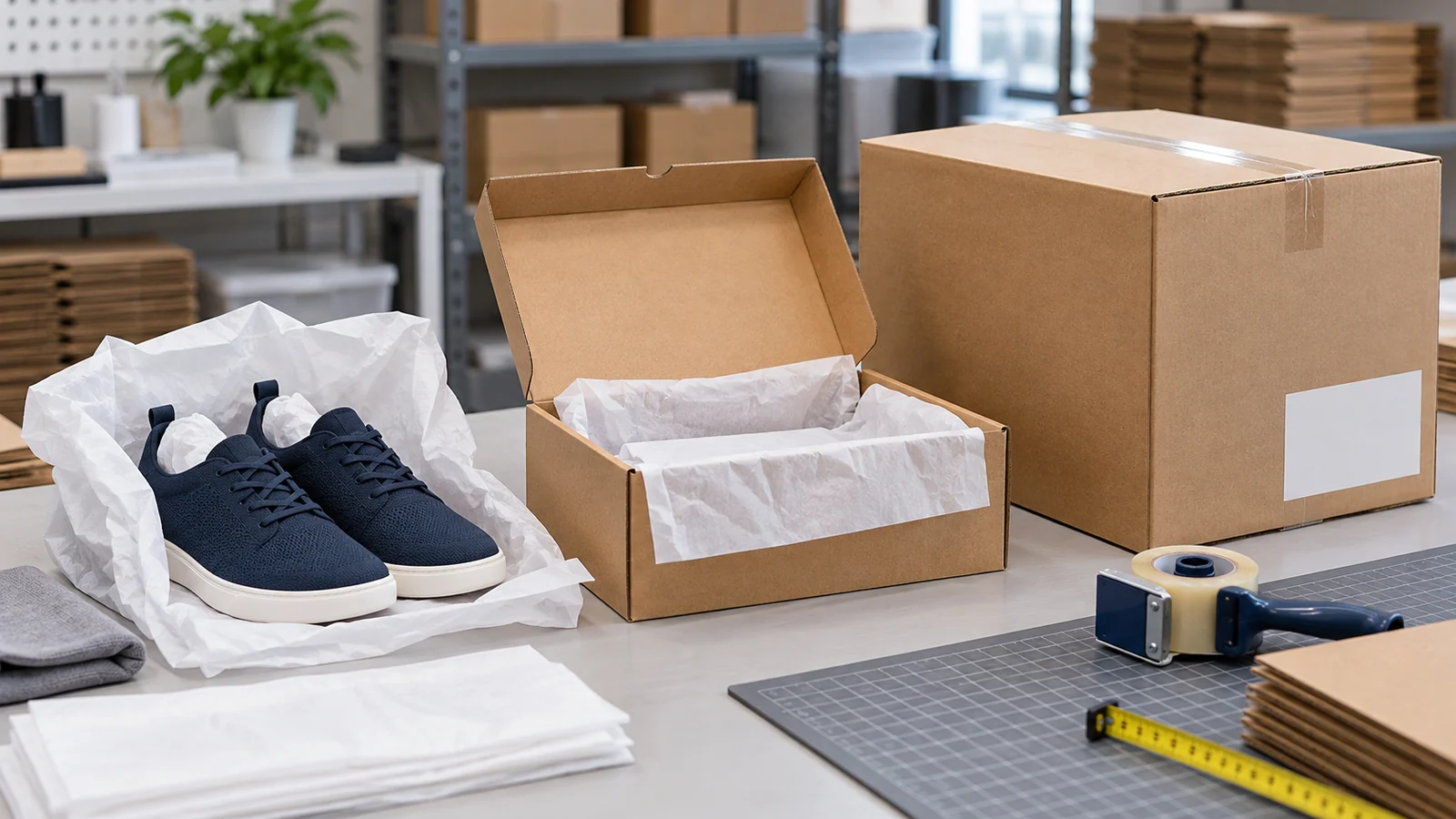
A complete packaging system can contain several layers:
Product preparation: shaping material, tissue, protective sleeves, hardware protection, or other agreed measures applied directly to the shoes.
Pair packing: arrangement of the left and right shoes, wrapping method, accessories, and documents inside the retail box.
Retail box: box structure, dimensions, material, printing, labels, ventilation, and closure.
Master carton: the shipping carton that contains multiple shoe boxes or packed pairs.
Identification: style, color, size, barcode, purchase-order data, carton number, destination, and handling marks.
Shipment records: packing list, carton breakdown, gross and net weight, dimensions, and any customer-specific logistics data.
These elements should work together. A strong outer carton cannot correct a shoe box that is too small, and accurate paperwork cannot prevent errors if labels on the product, box, and carton do not match.
Start With the Actual Packed Product
Why generic shoe-box dimensions are unreliable
Shoe-box size depends on product type, size range, pair arrangement, and the amount of protection needed. A low-profile flat and a tall boot do not require the same volume. Even within one style, the largest size may determine the retail-box dimension used across a range.
Do not select a box solely from a catalog description such as “standard men's box.” Ask the supplier to confirm the internal fit using the approved product, in the intended pair orientation, with all packing materials included.
Evaluate product-specific risks
Review how the product can be affected during packing and transport:
Can the upper crease or collapse?
Can metal ornaments scratch the opposite shoe?
Can light-colored materials pick up color or dirt?
Can a pointed toe, heel, buckle, or outsole edge damage the box?
Does the product need ventilation or moisture-control consideration?
Could printed tissue or packaging transfer color?
Are accessories able to move freely and mark the product?
The answer is not always to add more material. Packaging should use the least complex system that protects the product and satisfies customer requirements. Excessive filling can deform the shoe, increase volume, or create unnecessary waste.
Approve the packing method visually and in writing
A packaging specification should include images or diagrams showing shoe orientation, tissue placement, inserts, accessory position, label location, and box closure. Written descriptions should identify materials and quantities without relying only on a sample that might be lost or misinterpreted.
Record the approved sample version and date. If the product dimensions change during development, recheck the packaging fit.
Specify the Retail Shoe Box
Internal and external dimensions serve different purposes
Internal dimensions determine whether the packed pair fits without harmful compression or excessive movement. External dimensions affect carton configuration, pallet or container use, warehouse shelving, and freight calculations.
State which dimensions are being reported and use a consistent order, such as length × width × height. Confirm the unit of measure. A spreadsheet containing unlabeled numbers can easily be interpreted incorrectly.
Define structure and material without unsupported claims
A shoe-box brief may identify board type or grade, construction, printing method, surface finish, color, ventilation, recycled-content requirement, and performance expectations. The buyer should request supporting documentation for any environmental or material claim that will be communicated publicly.
Avoid vague phrases such as “eco-friendly box” without a defined basis. A more trustworthy requirement names the requested material attribute, evidence, and applicable market or customer standard.
Keep graphics and data controlled
Separate permanent artwork from variable data. Brand graphics may remain constant, while style, color, size, barcode, country-of-origin wording, or purchase-order data can vary.
Provide print-ready artwork and a data table from an approved source. Confirm:
box logo and text placement;
required legal or commercial wording;
label size and location;
barcode type and data owner;
human-readable style, color, and size information;
language requirements;
color and print expectations;
approval process for proofs or samples.
Do not ask a supplier to guess barcode content. The buyer or authorized data owner should provide or approve the number and verify that it matches the product record.
Design the Master Carton Around the Retail Box
Determine carton configuration
After approving the retail-box dimensions, evaluate how boxes will be arranged inside the master carton. The plan may be solid-size, mixed-size, solid-color, mixed-color, or another customer-defined assortment.
Document:
number of pairs per carton;
box orientation and layers;
style, color, and size assortment;
internal and external carton dimensions;
gross and net weight;
carton numbering logic;
whether inner cartons, dividers, or void fill are required;
destination or account-specific limits.
The maximum practical carton quantity is not simply the largest number of boxes that can be forced inside. The carton must remain manageable, protective, and compliant with the receiving customer's rules.
Retailer and distribution-center requirements vary
Large retailers and marketplaces often publish their own vendor manuals covering carton dimensions, weight, labels, packing, barcode placement, and advance shipment data. These rules are customer-specific. For example, Foot Locker publishes vendor guidance with detailed packing and label expectations, but that document should not be treated as a universal footwear standard.
Ask the customer for the current routing or vendor guide and record its version. If a retailer requirement conflicts with the normal factory packing method, resolve it before boxes and cartons are ordered.
Avoid unnecessary carton variety
Too many carton sizes can complicate ordering, packing, storage, and freight estimation. Too few can create wasted space or poor protection. Group retail-box sizes where practical, but do not force significantly different products into one carton specification without checking fit and performance.
For a broad footwear program, a carton matrix can help:
Product or box group | Retail-box external size | Boxes per carton | Carton external size | Gross-weight target | Status |
|---|---|---|---|---|---|
Group A | To be measured | To be tested | To be confirmed | Customer limit applies | Pending |
Values should come from packed samples and a verified trial, not from a generic template.
Understand Volumetric Weight Without Guessing the Rule
Carriers may charge according to actual weight or dimensional, also called volumetric, weight. Dimensional weight is calculated from package volume using a carrier-defined divisor or conversion method. The applicable rule can differ by carrier, service, origin, destination, and unit system.
The safe planning method is:
Obtain the packed carton's verified external dimensions.
Obtain its verified gross weight.
Ask the freight forwarder or carrier which current dimensional-weight method applies to the intended service.
Compare chargeable weight scenarios before approving the packaging configuration.
Do not hard-code one divisor into all quotations or website content. Confirm it for the actual shipment. Even when freight is quoted by another method, reducing avoidable empty volume can improve handling and logistics efficiency.
Compare configurations before production
A packaging trial can compare two or more carton arrangements. Review:
product protection;
retail-box deformation;
carton utilization;
total cartons required;
carton gross weight;
handling practicality;
customer receiving rules;
freight quotation impact.
The smallest carton is not automatically the best carton if it crushes retail boxes or makes handling unsafe. The decision should balance protection, compliance, volume, and cost.
Prepare Accurate Carton Marks and Labels
Use one approved source of truth
Carton labels should draw from the final purchase order and approved product master data. Typical fields may include buyer, purchase-order number, style, color, size or assortment, quantity, carton number, destination, country of origin, dimensions, weight, and barcode or logistics code.
The exact fields depend on the customer and route. Do not add or omit data based solely on another buyer's label.
Reconcile every identification layer
The shoe marking, product label, retail-box label, carton label, packing list, and commercial records should describe the same product. Common mismatches include:
correct shoe in a box marked with another size;
correct boxes in a carton carrying the wrong color code;
carton quantity that does not match the packing list;
duplicate or unreadable barcodes;
outdated purchase-order or destination data;
mixed assortments packed in the wrong ratio.
Create a final data review before label printing. If data changes, withdraw obsolete files and issue a new controlled version.
Test barcode readability in context
A visually clean barcode is not necessarily scannable. Verify the encoded data, print contrast, size, quiet zone, placement, and scanning result using the buyer's requirements. Curved, glossy, damaged, or poorly printed surfaces can reduce readability.
Barcode verification requirements vary. Agree on the method and evidence rather than making an unsupported claim that a label is “retail compliant.”
Send Your Packaging Requirements
Send LEFUSHOES your product type, size range, retail-box requirements, pairs per carton, label data, destination, and retailer manual. We can organize the packaging questions that should be confirmed during sample and quotation preparation.
Factory Testing and Packaging Trials
Packaging evaluation should reflect the product, route, customer requirement, and agreed quality plan. A factory may conduct packing trials, dimensional checks, weight checks, box-fit reviews, stacking observations, or other agreed evaluations. Formal transit or laboratory testing may be required by some customers or risk profiles.
Do not claim that an informal drop demonstration certifies a shipment. Test methods, conditioning, sample selection, acceptance criteria, and reporting should be defined when formal evidence is needed.
What a useful packaging trial records
A trial record can include:
product and sample version;
shoe size used, including the largest relevant packed size;
packing materials and quantities;
retail-box internal and external dimensions;
master-carton dimensions and construction;
pairs and arrangement per carton;
gross and net weight;
photographs before and after the trial;
observed box or product damage;
decision, corrective action, and approval.
This creates experience-based evidence without pretending that one trial represents every route or handling condition.
Shipment Inspection for Footwear Packaging
Shipment inspection can verify whether the approved packaging system has been followed. Depending on the inspection plan, checks may include:
pair packing and product protection;
correct retail box and label;
barcode content and scanning;
carton construction and closure;
carton marks and destination data;
pairs per carton and size assortment;
carton dimensions and weight;
packing-list reconciliation;
visible damage, moisture, contamination, or crushing.
Provide the inspector with the current packaging specification, approved artwork, purchase order, carton breakdown, and customer manual. If inspection instructions are vague, the inspector may confirm general appearance but miss account-specific requirements.
Inspection is a verification step, not a substitute for correct packaging development and in-process control. Errors discovered after all cartons are sealed can be costly to correct.
A Practical Packaging Brief for Buyers
Use the following sections to prepare a supplier inquiry or approval file.
Product information
style, construction, and size range;
largest packed size or separate box groups;
materials or details requiring protection;
accessories and documents packed with the pair.
Retail box
structure and material requirement;
approved dimensions or request for a packing trial;
artwork and print requirements;
box label data and placement;
environmental claim evidence, if required.
Master carton
pairs per carton;
solid or mixed assortment;
carton construction requirement;
customer dimension and weight limits;
carton marks, barcode, and numbering;
palletization or handling requirements, if applicable.
Logistics and approval
destination and transport mode;
retailer or marketplace manual;
freight-forwarder contact or calculation basis;
sample, proof, trial, and inspection requirements;
responsible approvers and deadlines.
Treat any preliminary dimension as provisional until it is confirmed with the final packed product.
Common Footwear Packaging Mistakes
Choosing the box before the shoe is finalized
Product changes can alter fit, protection, and carton configuration. Reconfirm packaging after material, construction, or size-range changes.
Reporting dimensions without saying internal or external
This can cause incorrect carton and freight calculations. Label dimension type, order, and unit every time.
Copying another retailer's carton rules
Vendor manuals are customer-specific and can change. Obtain the current requirements for the actual account.
Letting suppliers invent variable label data
Style, size, barcode, purchase-order, and destination data should come from an approved owner and controlled file.
Optimizing only for the fewest cartons
Over-compression can damage products or retail boxes. Balance protection, handling, customer limits, and freight.
Making vague sustainability claims
Define the material attribute and retain supporting documentation. Avoid broad public claims that exceed available evidence.
Frequently Asked Questions
What is a standard shoe-box size for wholesale orders?
There is no single reliable standard for every shoe. Box dimensions depend on product type, size range, pair arrangement, and protective materials. Measure and test the actual packed product, especially the largest relevant size.
How many pairs should be packed in one master carton?
The answer depends on retail-box dimensions, carton construction, weight, handling, customer requirements, and the desired size assortment. Confirm the configuration through a packing trial and the applicable vendor or logistics rules.
What is dimensional or volumetric weight?
It is a freight calculation based on package volume using a carrier-defined method. Carriers may compare it with actual weight to determine chargeable weight. Confirm the current formula for the specific carrier, route, service, and units.
Should every size use the same retail box?
Not necessarily. One box can simplify operations, but excessive empty space or compression can reduce efficiency or protection. Buyers may group compatible sizes into box formats after checking packed fit and carton impact.
What packaging items should be checked before shipment?
Check product preparation, pair packing, retail boxes, labels, barcodes, carton construction, carton marks, assortments, dimensions, weights, and packing-list accuracy according to the approved specification and inspection plan.
Conclusion
Footwear packaging and carton planning should move from the product outward. Confirm how the finished pair must be protected, approve the retail box, test the master-carton arrangement, verify current customer and carrier requirements, and control all label data from one source.
This approach produces more useful quotations, reduces packing changes, supports shipment inspection, and gives logistics partners better information. It also keeps packaging claims grounded in documented materials and verified measurements rather than generic assumptions.
Get a Packaging-Based Quote
Contact LEFUSHOES with your footwear specification, size range, packaging artwork, carton-assortment needs, destination, and customer routing guide. Request a quotation and packaging discussion based on your actual order requirements.
Related Footwear Buying Guides
Coordinate your packaging plan with our shoe size and size-run guide and pre-shipment inspection checklist. Browse the LEFUSHOES footwear collection or send your order requirements for style-specific information.